[re]visions: Revision is going back and looking at the work one has done and changing it and manipulating it to make it better. With architecture, this could mean making something of a different scale or style or simply changing a design for structural purposes.
audience: In design, the building or space needs to fulfill the characteristic of delight. This means that it needs to appeal to its audience. For example, if you were to design a space meant for children, it would need to appeal to them. This could involve things to climb and play on and bright, fun colors. Another example would be Versailles. It was designed to please the King of France and to show that he had the most money and the most fabulous house. It was to be large and elegant to show his power and his royal status.
Transition: Throughout time, architecture has been through many transitions. From the early civilizations to modern day, architecture has been revised and changed. Transition is also very important when creating a presentation because you need to be able to move form one thing to another. The project need to be understandable to those who look at it so that the information can be put across in a neat and readable fashion.


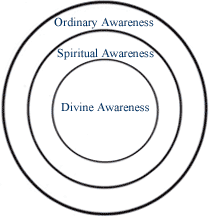
http://www.beliefnet.com/imgs/tout/story/keating_awareness.gif
Diagrams are used to better explain a site or a plan to someone. There are different diagrams to show different things. A few are context, matrix, and bull’s-eye. “For example, a highly useful type of plan is a diagram that, in presentation, acts as an informative link between site analysis findings and the more formal communication of the design solution” (Porter, Goodman 28). Diagrams can show how people move within a space, what is around that space, and what the functions are for different parts of a building or space. These things can be shown using color or different types of shading, from shading to crosshatching.
“Another plan drawing which is seldom made is a composite drawing of the context into which a building is to be placed” (Lockard 28). A contextual diagram refers back to the composition of a building or space, by showing what is around it. This could be anything from other buildings to streets to trees and other vegetation. Nicole Robert and I were actually given the task of drawing the contextual diagram for the Mossman building. We drew the building with the sidewalks, streets, and parking lots around it. We also put a few of the buildings that were close to it.
Detail drawings are usually closer up than perspective drawings. A detail drawing does exactly what it says. It shows the detail of a certain item. One example of this is our assignment for drawing. We had to each pick a detail that was specific to our building. I chose to do a detail of the brick floor. I chose this because bricks are something the Mossman building has a lot of. The walls, outside walkways, and floors are all made of brick. No other building on campus uses brick for as much s the Mossman building.

http://www.mattmurray.eu/images/_MCM0034.jpg
Impression can be like the feeling one gets from a work of art, and building, or a space. The Gothic Cathedrals are a good example because of the impression they have upon a person. When you first walk in, the size of the structure itself and its complexity can cast a feeling of awe on those who see it.


Scale is used for many different things in Architecture. In drawing, whatever is closest to you is bigger and as it moves back, it gets smaller. So if you had a crowd of people, then the people in front would be larger in scale than those in the back of the crowd. Also, scale is a way of showing power or hierarchy. This is shown in the pyramids, ancient Greece, and many other places all over the world. Normally, the larger buildings have a religious or political use or power. We also use certain scales to show a room, building, or piece of furniture in a smaller way, so as it will fit on paper or board. One example of this was drawing a plan view of Pat's chair in 3": 1' 0" scale.


When you illuminate a picture or drawing, you are making it pop from its background; making it stand out. The pyramids in Mexico are actually illuminated by the surrounding area. The green in the forest and landscape make the brown of the stone temples stand out. This draws attention to them.


MULTIVIEW: With multiview, a reader can see a story from different points of view. One example of this is the play A Midsummer's Night Dream. The story is told from the views of the main characters. One specific point of the play is Bottom's dream when the fairy queen is in love with him. This part is seen from the view of Bottom, the Fairy Queen, Puck, and Oberon. This gives the audience or the reader different ideas about the scene and how different characters feel about certain situations.

ARTIFACTS: Artifacts play an important role in story telling and in stories themselves. They assist in the development of a story. For example, in The Three Spinners, the spinning wheel is the main object used in the story. Without it the girl and the spinners would not be able to carry out the tasks set for them in the story. Also, in A Midsummer's Night Dream, the flower is the beginning and one of the causes of all the chaos. With out this artifact, the characters would not have fallen in love with whom they did, thus completely destroying the story line. Artifacts, therefore, play a huge role in any story.